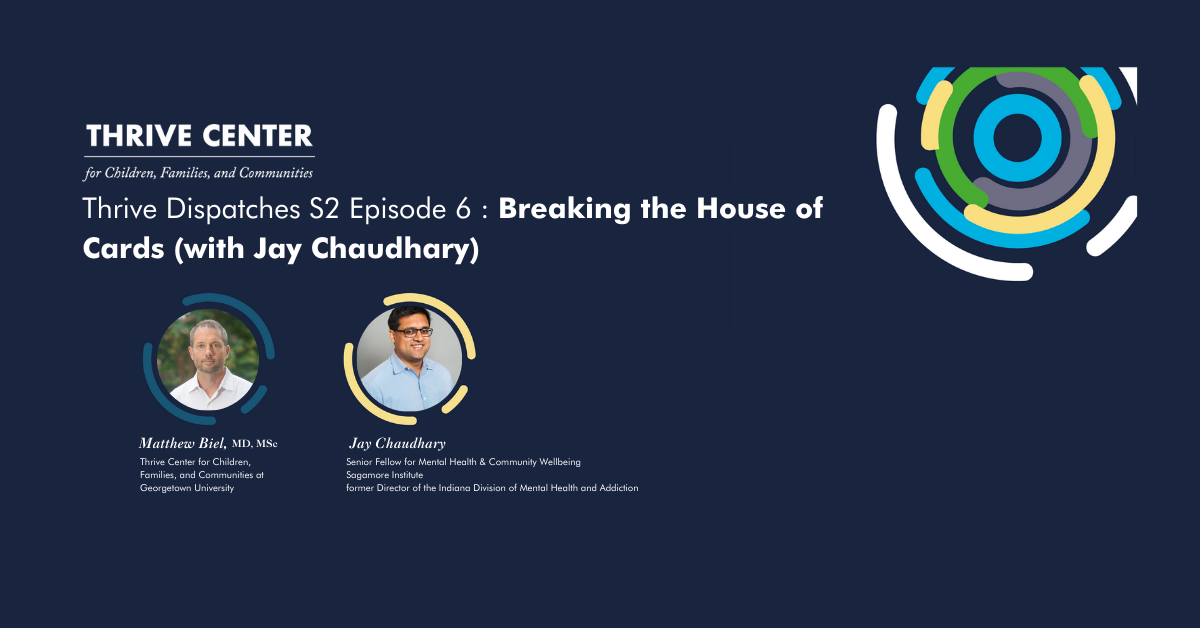
In this episode, Dr. Matt Biel speaks with Jay Chaudhary, former Director of Mental Health and Addiction for Indiana, about transforming an entire state’s behavioral health system. Jay describes the mental health financing system he inherited as “a house of cards built on top of a shell game,” where providers were locked into rigid financial formulas that made any deviation potentially catastrophic.
Jay’s journey began as a civil rights lawyer launching medical-legal partnerships that placed attorneys directly in healthcare settings to address the social drivers that keep people sick. That experience taught him that clinicians’ understanding of their work transforms when they see how much their clients’ lives outside the clinic affect them, and more importantly, that “we can do something about it through collaboration.”
As state director, Jay discovered that incremental changes were impossible in such a fragile system. His solution was comprehensive: implementing Certified Community Behavioral Health Clinics (CCBHCs) that use cost-based reimbursement, giving providers flexibility to actually respond to community needs. The transformation required not just policy change but alignment across stakeholders, from legislators to law enforcement to providers, all using the same language: “someone to call, someone to respond, somewhere to go.”
For questions, comments, or ideas for future episodes, please email us at: thrivecenter@georgetown.edu.
Download Full Transcript
In this excerpt, Jay explains the fundamental problem with the mental health financing system:
This interview has been edited for length and clarity.
Jay: Like it was described to me by people in the system. This is a direct quote as a house of cards built on top of a shell game like that. That’s how the people in the system described it to me when I was starting out. Meaning, you know, you think about those metaphors like how you, you know, pull one card out the entire house topples.
Matt: So incremental changes to the system were not also possible?
Jay: So that’s the background, like at high level as possible about the sort of financial infrastructure…So then you figure out, okay, so I have this, I have to explain it. I’m making decent traction, explaining it to people, like explaining it to legislators and, and the governor’s office and, and, and sheriffs and, and all the other kind of big stakeholders like, Hey, we need a big change.
And then you’re like, okay, what’s that big change? Right? Like that’s, that’s, you know, that, ha it’s only half defining the problem is only half the job. Like what’s, what’s your solution to this problem
Listen to the full episode