Practical Certificate in Infant & Early Childhood Mental Health Consultation

Become An Infant & Early Childhood Mental Health Consultant

The most affordable, practical, and flexible IECMHC certification in the country. Built by the people who wrote the national competencies.

Join our founding cohort in October 2026. Questions? Contact us

Program at a Glance

CohortOctober 2026 (starts October 13)
Seats250
Length12 months total (4-month certification + 8 months of included support)
Format100% virtual (self-paced + weekly live sessions)
TimeAbout 3.5 hours per week
Tuition$3,000, complete program

Open to individuals enrolling themselves and to organizations enrolling their staff as a team.

A Black child and his father speak to a person who is just out of frame


Every Early Care, Education and Home Visiting Program Can Use More Consultation


Our research on the state of IECMH and consultation revealed three themes:

Quality

Right now, there’s no national standard for who can be an IECMH consultant. Programs either pay for a fully licensed clinician with early childhood experience (that they can’t afford), or make do with who’s available.

  • “We had limited choices and had to take who would come.”

Practicality

There are excellent foundational programs but they’re very theoretical. There’s a need for a maximally practical program that teaches classroom realities, teacher trust building and navigating the day-to-day.

“Even after training, consultants often feel unprepared for day-one work.”

Affordability

In the current funding environment, there’s a need for affordable pathways into consultation as well as post graduation supervision, mentorship, and ongoing training.

“I can’t justify many thousands of dollars in training when I’m making $50k/year.”

The Standard of Competence


Maximizing the reach and impact of consultation by training, certifying, and developing the next generation of consultants.

Maximizing AccessibilitySelf-paced modules coupled with weekly virtual sessions.
3.5 hours weekly time commitment.
Day-1 Readiness & BeyondEight months of group supervision by a licensed clinician, plus ongoing professional development, all included.
Built by the Field’s LeadersLed by Dr. Neal Horen and the Center of Excellence team.
Rooted in decades of research and field work.

Opening More Paths to Consultation


Not everyone enters from the same starting point. We meet you where you are.

Mental Health Pathway

For Mental Health Clinicians looking to add the consultation skillset.

For licensed mental health clinicians adding the consultation skill set. First, learn the realities of early childhood settings, roles, and routines, so you can consult with credibility from your first visit, even if you have never set foot in a classroom. Then, learn the competencies of effective consultation.

ECE Pathway

For Early Childhood Teachers & Directors


For early childhood teachers, directors, and home visitors. No clinical or mental health degree required. First, build foundational knowledge in attachment, trauma, child development, and observation. Then, learn the competencies of effective consultation.


“Grow Your Own” Consultants


Many Head Start and childcare programs want supplement external consultants with internal capacity. Why?
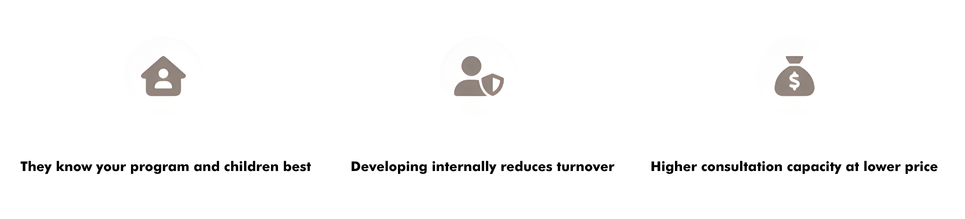
They know your program and children best, Developing internally reduces turnover, Higher consultation capacity at lower price

“Building internal capacity matters. Let’s ‘grow our own’ consultants.” – Head Start Collaboration Office Director

Contact us for Group Rates

NOTE: If a staff member you enroll leaves your program during the certification, we will train their replacement at no additional cost.

What You’ll Master: 8 Core Domains


This 4-month program covers the validated competencies that define effective IECMH consultation:

Foundations of IECMHCThe consultant role, distinguishing consultation from therapy, coaching, and training, and articulating your work to skeptical audiences.
Best PracticesTrauma, attachment, regulation, wellness, and recognizing secondary traumatic stress in consultees and yourself.
Program Evaluation & Evidence BaseOutcomes IECMHC measures, the Theory of Change, and how daily documentation connects to evaluation.
Assessment & ObservationStructured observation and tools (TPOT, Arnett CIS, SDQ, DECA, ASQ-SE), and translating data into recommendations.
The Consultative RelationshipBuilding trust with directors, teachers, and families, and navigating resistance and power dynamics.
The Consultation ProcessThe phases of consultation from initiation to closing, with practice scenarios at child, classroom, and program levels.
Equity in ConsultationBias, disparities in suspension and expulsion, culturally responsive practice, and difficult conversations.
Reflective Practice & SupervisionWhat reflective practice is, how reflective supervision differs from other supervision, and how to sustain yourself in the work.

How The Program Works

70% Self-Paced

  • Video lessons & case studies
  • Interactive scenarios
  • Reflection journals
  • Competency-based assessments

30% Live and Applied Sessions

  • Weekly live sessions (90 minutes each)
  • Case consultation & role-play
  • Q&A with Georgetown faculty
  • Scenario Practice
  • Final capstone

Instructors: Learn from the Experts

Dr. Neal Horen

Clinical Lead. Director of Infant, Early Childhood, and Relational Health at Georgetown, and Director of the Center of Excellence for IECMHC.

Lauren Rabinovitz

Lead Instructor, Research and Evaluation, and Program Director. Led the 31-state national scan behind the program.

Julia Sayles

Lead Instructor, Course Design. Practicing consultant and educator; helped build the Center of Excellence (Georgetown Model) curriculum.

Founding Cohort Opportunity

Enroll in the October 2026 Cohort. 250 seats. $3,000 for the complete program.

For Questions or Group Rates, Contact Us

Frequently Asked Questions


Two groups. Mental health clinicians who want to add the consultation skill set. And early childhood educators, directors, and home visitors who want to move into consultation. You do not need to already be a consultant to start.

It depends on your pathway. Pathway A is for licensed mental health clinicians. Pathway B is for early childhood educators and does not require a clinical or mental health degree. Most of our participants come through Pathway B.

Pathway A is for licensed mental health clinicians; it starts by grounding you in early childhood settings, roles, and routines. Pathway B is for early childhood educators; it starts with attachment, trauma, and child development. Both pathways then teach the same core competencies of consultation.

$3,000 for the complete program. That covers the 4-month certification, 8 months of group supervision and professional development, and all course materials. There are no add-on fees.

Not at this time. The program is self-funded and we do not currently have a scholarship pool.

Yes. Discounts are available for organizations enrolling 5 or more staff. Email si436@georgetown.edu and we will set it up.

Yes. We can split tuition into installments across the program. Email si436@georgetown.edu to set one up.

Tuition is non-refundable once the program begins on October 13, 2026. If you need to withdraw before the start date, email si436@georgetown.edu to discuss your options.

Yes. Many participants are sponsored by their Head Start program, agency, or employer. We can invoice your organization and accept payment by bank transfer (we provide a W-9) or by credit card. Many employers also reimburse tuition after completion.

Both. Individuals can enroll themselves, and organizations can enroll their staff as a team.

Yes. Many Head Start and childcare programs enroll several staff together to build internal capacity. We set up one point of contact and one invoice for the group, and discounts are available for 5 or more. Email si436@georgetown.edu to arrange a team enrollment.

If a staff member you enroll leaves your program during the certification, we will train their replacement at no additional cost.

12 months total. A 4-month certification, followed by 8 months of included support: group supervision led by a licensed clinician, plus ongoing professional development.

About 3.5 hours per week during the 4-month certification. Most of that is self-paced, with one live session each week.

It is 100% virtual. About 70% is self-paced, completed on your own schedule. The rest is live weekly sessions over video.

Group supervision led by a licensed clinician on our faculty, plus ongoing professional development: monthly lectures, guest speakers, and open office hours. It is designed to keep you supported well after the course ends, and it is included in tuition.

A Practical Certificate in IECMHC from Georgetown University’s Thrive Center. The program is crosswalked to help meet the requirements for IMH Alliance (AIMH) endorsement.

Yes. The program is competency-based and built for day-one readiness. You demonstrate skills through simulated consultations and a Capstone, not just tests.

They are two certificates with one mission. The Leadership Certificate is for the people who design the system: program directors, supervisors, policymakers, and agency leads. Over 9 months it covers how to fund, integrate, and evaluate consultation, and how to hire and work with consultants. The Practical Certificate is for the people who do the work: consultants, education managers, coordinators, clinicians, and coaches. It builds the eight competencies of consultation and demonstrated day-one readiness. Many organizations use both. Leaders design the system, and their staff do the work.

Georgetown’s Thrive Center is the home of the only federally funded national Center of Excellence for IECMHC. Our faculty helped write the national competencies the field uses. You learn from the people who set the standard.

The October 2026 cohort begins October 13, 2026. The cohort has 250 seats.