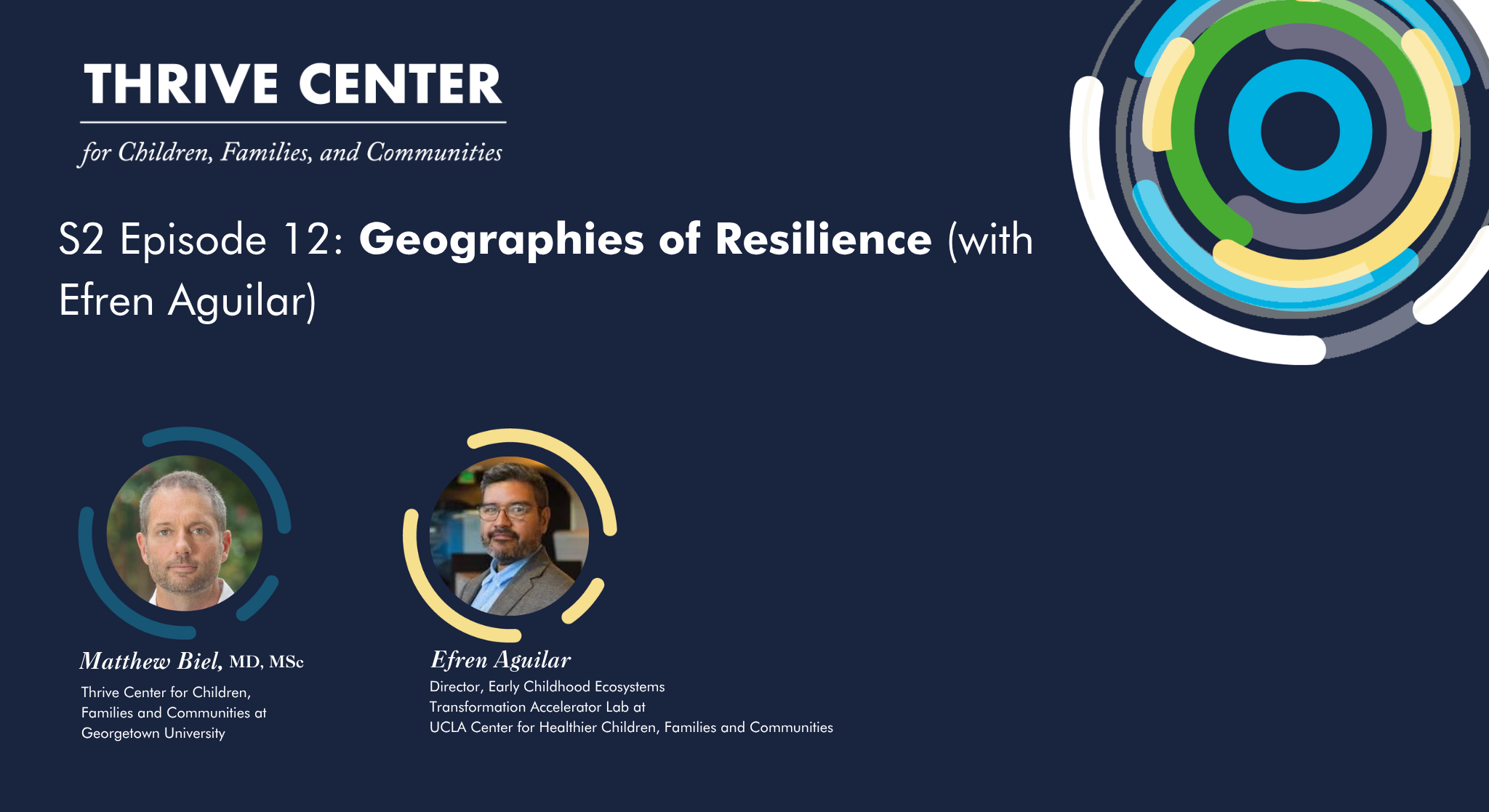
Efren Aguilar is a researcher and community engagement specialist at the University of California, Los Angeles, working at the intersection of early childhood measurement, spatial epidemiology, and systems transformation. Over a career spanning more than three decades, he has worked in domestic violence prevention, refugee support, homelessness, public health, and early childhood systems, treating each role as a study of a different stage of human development.
In this episode of Thrive Dispatches, Aguilar joins Dr. Matt Biel to discuss the 15 years he has spent building geographies of resilience, a way of mapping not only where communities are struggling but where they are doing well against the odds. The work started with an observation he could not yet explain. The same neighborhoods kept surfacing across unrelated data sets and methodologies, and funders were reading those concentrations as need. Concentrated hardship, he argued, is only half the measure. It says nothing about what people on the ground have already solved.
They discuss what his teams find when developmental outcomes are broken down by income and then by race and ethnicity, including the pattern in which Latino children in the poorest neighborhoods outperform the average across all groups, and that advantage erodes as families move into wealthier ones. They discuss what happens when data leaves the university. In New Mexico, residents named the geographies of resilience in their state before seeing any results, down to the census tract, and the data agreed. And they discuss Aguilar’s critique of improvement science, the method borrowed from manufacturing and hospitals for making incremental gains inside an existing system.
Two ideas hold the conversation together. A map of deficits produces deficit-shaped solutions: measure only what is going wrong in a place, and you cannot fund what is already going right there. And improvement is not transformation. A system can be made to run better and still deliver exactly what it was built to deliver.
For questions, comments, or ideas for future episodes, please email us at: thrivecenter@georgetown.edu .
Interview Excerpt
Efren Aguilar on what community members named before they saw the data:
“So before we brought the data to New Mexico, we met with a lot of folks, and we were asking them: What conditions do you think produces resilience? And they gave us these very interesting things that I had not heard of in other places because in New Mexico, there’s lots of indigenous tribal communities. And so they were talking about things like connection to the land and participation in sacred ceremony, and we asked them to identify geographies of resilience. This is before they saw any of the data. And they named them down to the census tract, Matt. It’s quite fascinating. They said, “In this neighborhood, you’re going to see resilience. In this neighborhood, you’re going to see resilience. In these neighborhoods, these rural areas, you’re going to see it.” And when we actually collected their data, that’s what we actually saw. And so it goes to show you that these folks who don’t consider themselves to be developmental experts, but they just are experts in their communities, have very sophisticated understandings of what produces resilience, and they named it.”
Download Full Transcript
Listen to the episode on Spotify
View the episode on Vimeo