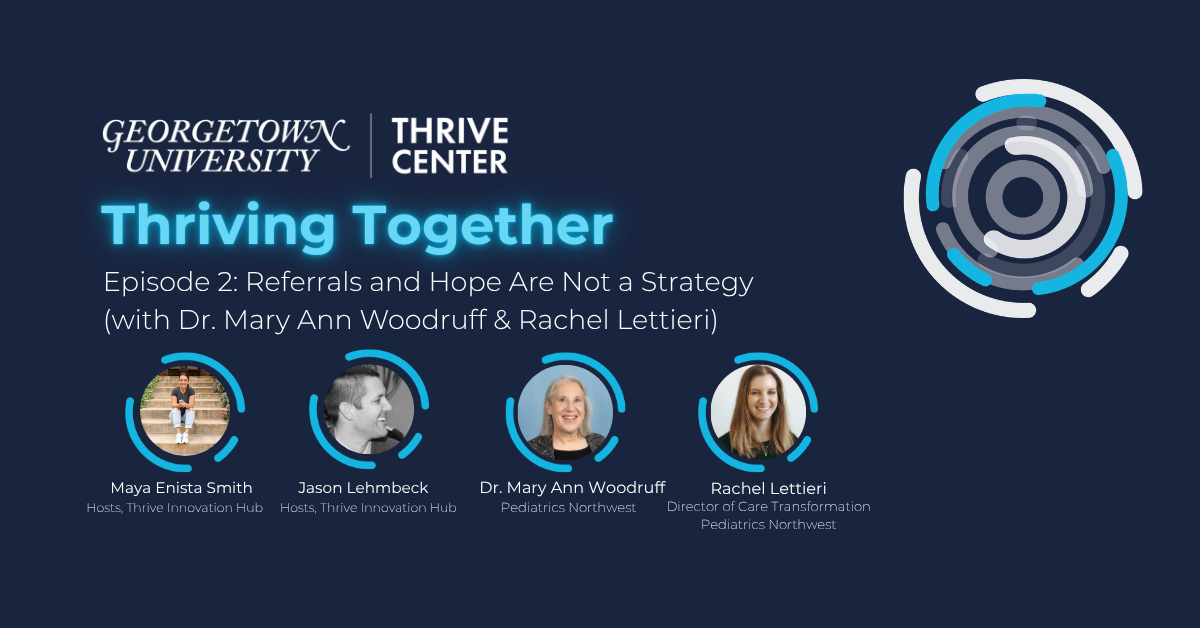
Thriving Together: Referrals and Hope Are Not a Strategy, with Dr. Mary Ann Woodruff and Rachel Lettieri (Pediatrics Northwest)
In this video episode of Thriving Together, hosts Maya Smith and Jason Lehmbeck speak with Dr. Mary Ann Woodruff and Rachel Lettieri, LCSW, of Pediatrics Northwest, a pediatric group that has served families in the South Sound region of Washington for more than 50 years.
Mary Ann is a general pediatrician who saw patients for 36 years and is now the Medical Director of Care Transformation as well as the Washington Medical Director for Reach Out and Read.
Rachel directs Care Transformation and built the practice’s community health worker division. Both were fellows in the Thrive Center’s Innovation Hub.
Pediatrics Northwest treats the pediatric medical home as a universal touchpoint, the one place nearly every family returns to with their child, and uses it to bridge physical health, behavioral health, and unmet social needs.
Community health workers from the community accompany families: they help navigate systems like early intervention and behavioral health, reduce stressors, and build the confidence to make a first call. The team has protected one non-billable day a week for community health workers to be out building relationships with the resources they connect families to, a choice they have held for four years even while billing Medicaid for those services. Their work grew from a Medicaid waiver grant for collaborative care and behavioral health integration in 2018 and 2019, and it is part of Pediatrics Supporting Parents, a five-community national initiative with Zero to Three to strengthen early relational health in well-child visits.
The through-line, in Mary Ann’s words: children’s brains develop in relationships, not systems, and so our systems have to catch up with that science.
For questions, comments, or ideas for future episodes, please email us at: thrivecenter@georgetown.edu .
Interview Excerpt
(Edited for length)
Maya: From your vantage point, what did you see happening repeatedly that made you think, we have to do this differently?
Rachel: What we kept seeing over and over again were families coming to us with complex needs that were never purely medical. A child might be showing developmental delays, behavioral dysregulation, or anxiety. But underneath that, there were often things that the pediatrician was not able to address, not for lack of caring, but lack of time: food insecurity, caregiver stress, lack of childcare, difficulty navigating systems like early intervention or behavioral health. What was really striking to me is that families weren’t failing to follow through because they didn’t care. They were actually trying really hard. They were just trying to navigate so many fragmented systems that weren’t built to work together. We realized that pediatric care needed to do more than just diagnose and refer. We really needed to help families navigate the systems, reduce stressors, and strengthen relationships, because those are the conditions that allow kids and youth to thrive developmentally.
Download Full Transcript
Listen to the episode on Spotify
View the episode on Vimeo