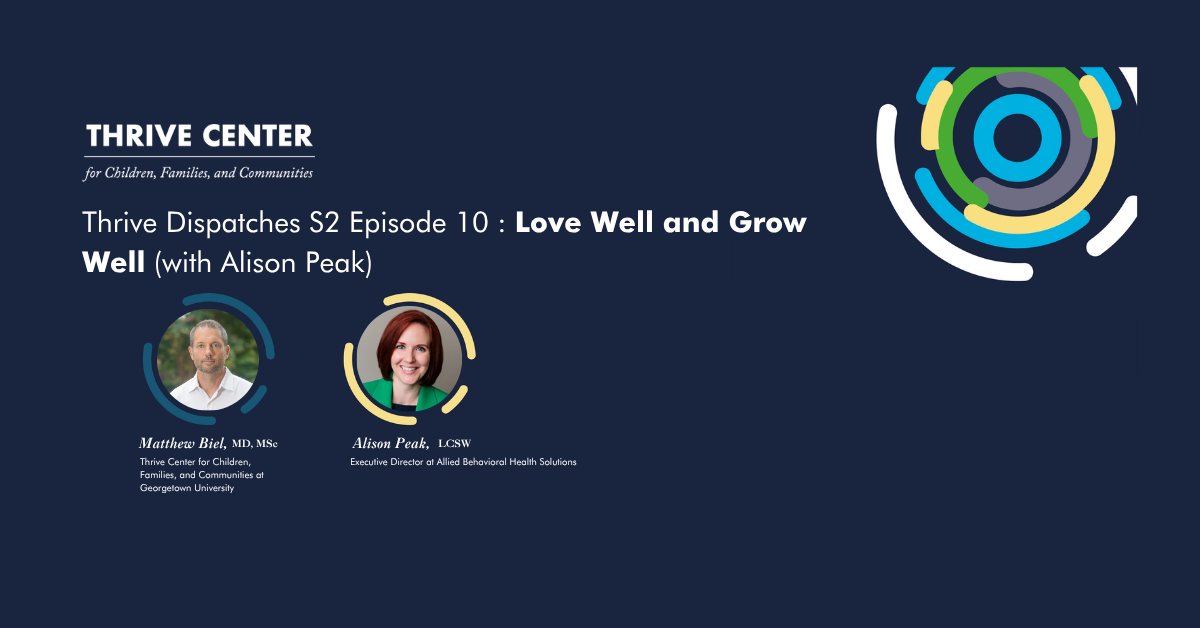
In this episode, Dr. Matt Biel speaks with Alison Peak, a clinical social worker specializing in early childhood mental health and the Executive Director of Allied Behavioral Health Solutions, a behavioral health practice with sites across Tennessee.
Before any of that, Alison grew up deep in the Appalachian Mountains of Virginia, in a place where predictable routines created safety even during times of scarcity, and where relationships were the foundation of a wide web of informal support.
In their conversation, Alison and Matt explore the difference between formal systems, the agencies with long acronyms and eligibility requirements, and the informal ones, the networks of relationships and predictable rhythms that decide who shows up for whom when times get hard.
Alison’s clinical anchor is a definition she returns to often. “My favorite definition of infant and early childhood mental health is the capacity to love well and grow well.”
For young children, she explains, relationships are not one factor among many. They are the thing that determines whether a child makes it to adulthood at all.
That same relational lens shapes how she helps multiple agencies coordinate around a single family. When a pediatrician, a school, child protective services, and a court each speak their own professional language, Alison says, part of the job of a good mental health provider is “to be the interpreter across six different systems” and to help everyone see that they are often asking for the same thing. Her team’s internal mantra is “slow is smooth and smooth is fast.”
The conversation closes on reflective supervision, which Matt calls not a luxury but the essential tool that makes good care possible. Alison’s team recently completed a seven-year longitudinal study showing that effective supervision increases workforce retention, raises staff confidence, and lowers secondary traumatic stress – so that people “leave at the end of the day feeling like they did a job well.”
For questions, comments, or ideas for future episodes, please email us at: thrivecenter@georgetown.edu .
Download Full Transcript
Listen to the episode on Spotify
View the episode on Vimeo